
Samsung has begun teasing its upcoming Exynos 2600 processor, which is expected to power select models of the Galaxy S26 lineup. While official specifications remain limited, the chip is being described as one of the most significant Exynos releases in years. Recent reports now suggest that it will feature a new thermal solution called Heat Pass Block technology.
Heat Pass Block cooling for Exynos 2600
According to a report from South Korean outlet ET News, Samsung presented its Heat Pass Block (HPB) cooling system to the media on November 11, 2025. The new cooling approach relies on a passive copper heat-dissipation structure designed to manage the processor’s thermal output more efficiently. What sets HPB apart is its direct integration into the system-on-chip itself, allowing heat to be transferred away from critical components more quickly and effectively.
This built-in cooling design could help the Exynos 2600 maintain stable performance under heavy workloads, addressing one of the longstanding challenges associated with high-performance mobile processors.
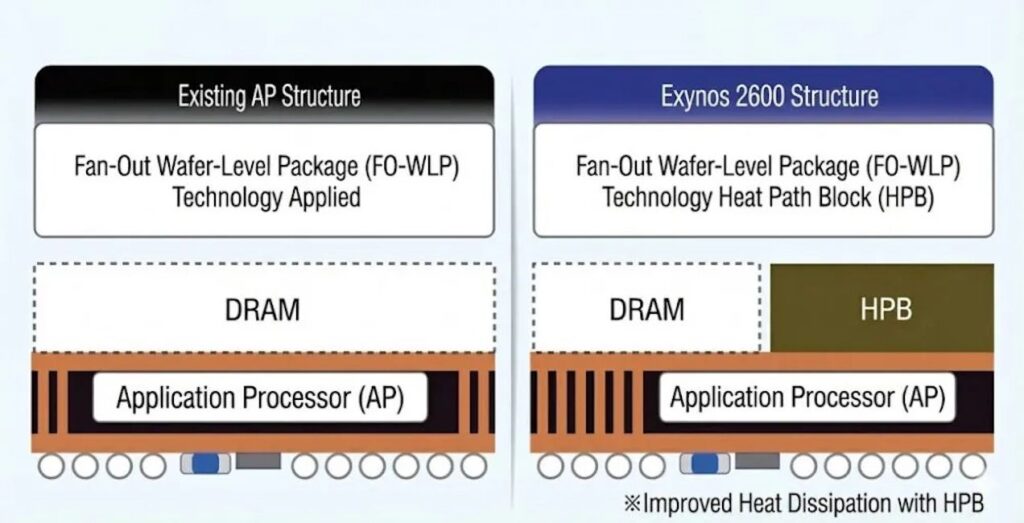
The Exynos 2600 will be the first mobile processor to feature Samsung’s Heat Pass Block technology, marking its debut in smartphones. Until now, passive cooling solutions of this kind have largely been limited to PCs and server-grade hardware. Samsung has reportedly confirmed that integrating HPB directly into the Exynos 2600 improves thermal efficiency by around 30 percent compared to its previous-generation chipset.
This advancement represents a significant step forward for smartphone thermal management, particularly for Exynos-powered devices. Historically, one of the most common criticisms of Samsung’s Exynos processors has been performance drops caused by inefficient heat control and aggressive thermal throttling. With HPB, Samsung appears to be addressing this long-standing issue head-on.
With the introduction of Heat Pass Block technology, Samsung could not only address long-standing thermal issues in its own processors but also influence the wider semiconductor industry. According to ET News, Samsung Foundry is opening access to this proprietary cooling technology for external partners, allowing other chipmakers to integrate HPB into their processors.
If adopted broadly, this move could trigger two major shifts in the chip market. First, it may challenge TSMC’s long-held dominance in advanced semiconductor manufacturing. Currently, companies such as Qualcomm, MediaTek, and Apple rely almost entirely on TSMC to produce flagship chips like the Snapdragon 8 Elite Gen 5, Apple A19 and A19 Pro, and the Dimensity 9500. The availability of HPB through Samsung Foundry could encourage these players to reconsider their manufacturing strategies.
Second, widespread adoption of HPB could significantly reduce, or even eliminate, thermal throttling across high-performance mobile chipsets. However, this advancement may come at a cost. Integrating advanced cooling directly into chip architecture is likely to increase fabrication expenses. As a result, while users could benefit from smoother performance and fewer overheating issues, smartphones powered by such processors may become more expensive.
With the global chipset supply and pricing pressures already affecting the industry, any increase in manufacturing costs could ultimately be passed on to consumers, potentially pushing flagship device prices even higher.


