
Apple’s much-rumoured foldable iPhone is reportedly abandoning facial recognition to address challenges linked to its folding design.
As 2025 draws to a close, excitement around Apple’s first foldable iPhone is reaching new heights. The device is expected to be officially revealed in 2026, with reports suggesting that large-scale manufacturing may already be underway. A fresh leak now sheds light on some of the hardware choices Apple may adopt for this upcoming smartphone.
iPhone Fold may rely on Touch ID instead of Face ID
According to Weibo tipster Digital Chat Station (DCS), Apple’s current foldable iPhone prototype includes a fingerprint sensor integrated into the side button. This aligns with earlier insights from analyst Ming-Chi Kuo, who also indicated that Touch ID would replace Face ID on the iPhone Fold. While Kuo did not explain the rationale, DCS has now provided additional context.
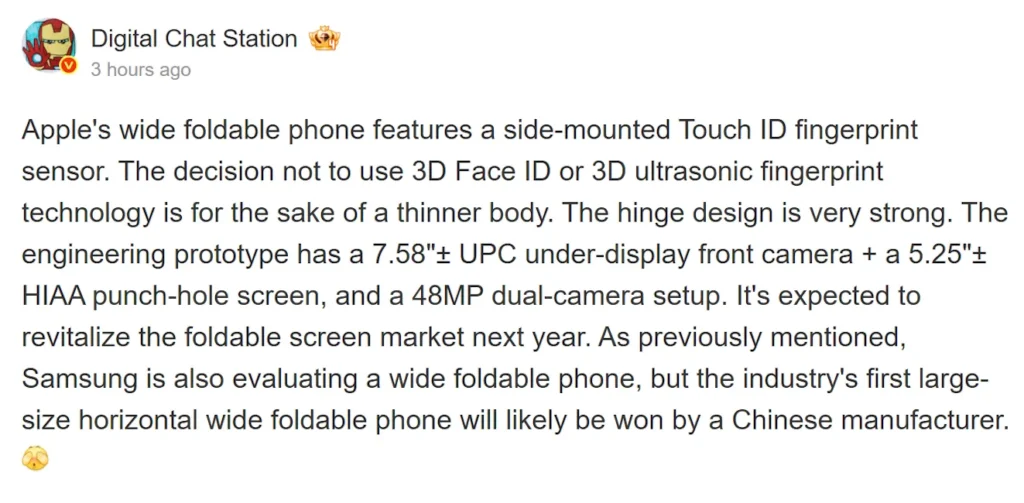
The report suggests that Apple opted for this change to keep the foldable iPhone extremely slim and refined. For the same reason, the company is also said to have ruled out an ultrasonic fingerprint scanner. As a result, users can expect a thin chassis paired with a side-mounted Touch ID solution.
Despite its slender profile, the device is not expected to compromise on durability. DCS claims that the prototype features a highly robust hinge mechanism. Previous reports also indicated that Apple plans to use Liquid Metal components along with a specially designed internal metal plate to reduce visible creasing on the foldable display.

These internal plates are reportedly being manufactured by South Korean firm Fine M-Tec and are designed to distribute folding stress evenly, helping achieve a more seamless, crease-minimised screen. Apple is also believed to be collaborating with Samsung for the supply of foldable OLED panels for its book-style foldable iPhone.
In addition, the device is expected to include an under-display front camera on its inner 7.58-inch screen, while the outer 5.25-inch display may retain a punch-hole camera cutout. The rear camera system could consist of a dual 48MP setup.
That said, Apple has not officially confirmed any of these details. Based on current leaks and industry reports, the foldable iPhone is likely to launch in late 2026, with an estimated price ranging between $2,000 and $2,500.


